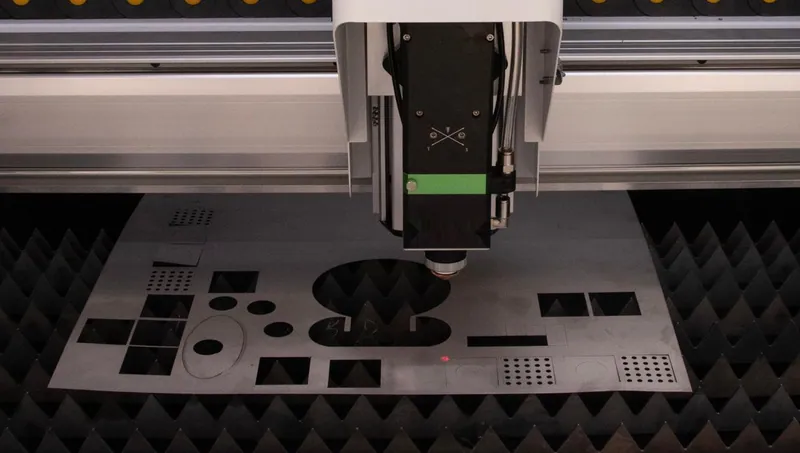
We cut SS 304 sheet with nitrogen, which leaves a clean, bright edge with no oxide on it. A person checks every drawing before it is cut. The flat parts are cut in Bengaluru and couriered anywhere in India.
The sheet we cut: AISI 304 in 2B finish
The sheet is AISI 304, the common chromium-nickel stainless steel that is often called 18/8. It does not rust in normal use, it welds well, and it is the usual grade for kitchen, food and pharma equipment.
2B is the standard mill finish: smooth, flat and silver-grey with a soft sheen. It is not a mirror finish and not a brushed (hairline) finish, and light handling marks are normal on mill-finish sheet. If you need a brushed or mirror face, send a custom request.
304 handles rain, kitchens and most outdoor use. Parts that sit in sea water or strong chemicals are normally made in SS 316. That grade is not on the instant quote, so send a custom request for it.
How the laser cuts stainless and what the edge looks like
We cut stainless on a fibre laser with nitrogen as the assist gas. Nitrogen does not react with the metal. It simply blows the molten steel out of the cut, so the edge stays bright and free of oxide.
That clean edge can be welded without grinding first. Thin sheet comes out close to burr free. Thicker sheet shows fine vertical lines on the edge and can carry a light burr on the underside. Typical tolerance is about ±0.2 mm, and the kerf is about 0.1 to 0.3 mm.
Designing SS parts, name plates and jali
Keep holes and slots at least as wide as the sheet is thick. Put every hole you can into the drawing: 304 work hardens, so drilling it by hand later is slow and hard on drill bits.
The instant quote cuts right through the sheet. It does not engrave or etch. So an SS name plate is made in one of two ways: letters cut out of a plate, or separate letters cut and mounted on a backing. For cut-out text, use a stencil font or add small bridges, otherwise the centres of letters like O, A and D fall out. Convert text to outlines before you export the file, because text objects are not cut.
For SS jali, keep every bar joined to the frame and at least as wide as the sheet is thick. Dense patterns put a lot of heat into thin sheet and can bow it slightly, so pick a thicker sheet for large panels. Panels up to 1000 × 600 mm are on the instant quote. Larger ones, up to a 2500 × 1250 mm sheet, go through a custom request.
After cutting: deburr, brush, polish, weld
You receive flat cut parts in the 2B mill finish. Edges and corners are sharp, so handle them with gloves and break the edges with a file or a fine flap disc.
Stainless needs no paint. For a decorative look it can be brushed or polished after cutting. Use tools kept only for stainless: a wire brush or grinding disc that has been used on mild steel leaves iron particles behind, and those show up later as rust spots.
After welding, clean off the heat tint to keep the full corrosion resistance. Bending up to 3 mm can be added on the quote page; tapping, countersinking, welding, polishing and engraving are not part of the instant quote. If you need any of them, send a custom request.
SS 304, MS, GI or aluminium?
Stainless costs more than mild steel, both for the sheet and for the cutting. It earns that when the part must stay clean and rust free with no coating: food contact, wash-down areas, outdoor signs and fittings.
If the part will be painted or powder coated anyway, mild steel does the same job for less. For thin indoor covers, GI sheet is a low cost middle path. If weight matters more than hardness, look at aluminium.