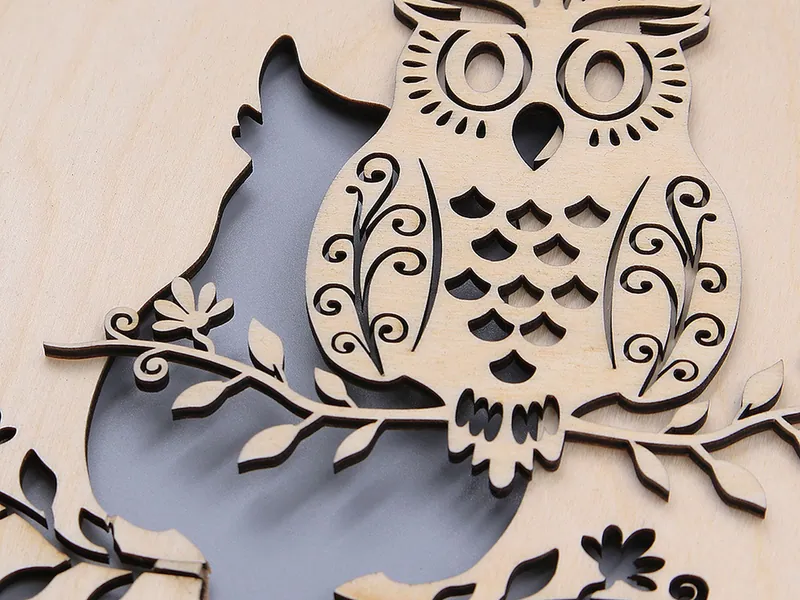


People looking for wood laser cutting often start here. MDF has no grain or knots, so fine detail cuts evenly in every direction. It is the board on the instant quote for MDF jali cutting, craft work and school projects. For plywood, send a custom request.
The board we cut: plain interior-grade MDF
MDF stands for medium density fibreboard: fine wood fibres pressed with resin into a flat, even board. The board we cut is plain, interior-grade MDF. Its smooth faces are ready for primer and paint.
It is for indoor use only. MDF soaks up water and swells if it gets wet, and it does not recover. It is also not a structural board: thin sections snap easily.
Laser-cut MDF is a thin board. Thick MDF, such as the board used for doors and free-standing partitions, is normally cut on a CNC router, which is a different process from laser cutting.
How the laser cuts MDF and what the edge looks like
MDF is cut on a CO2 laser, which burns a narrow line through the board. The cut edge is dark brown and lightly charred. The kerf is a little wider than in metal, and typical tolerance is about ±0.2 mm.
The faces can show a light smoke stain close to the cut, and fresh parts carry a burnt-wood smell. The stain wipes or sands off, and the smell fades over a few days in open air. A coat of primer and paint covers what is left.
Designing MDF parts and MDF jali
Holes and slots should be at least half the board thickness wide, and never under 1 mm. Keep the bars and bridges of a pattern at least as wide as the board is thick, and wider on big panels. Thin bars char through and break in handling.
For MDF jali cutting, every bar must stay joined to the frame, or it drops out as a loose piece. Leave a solid border around the pattern so the panel can be handled and fixed into its frame. Panels up to 1000 × 600 mm are on the instant quote. Larger panels go through a custom request.
For slot-together models and boxes, allow a little clearance in the slots, because board thickness varies slightly. Very small pieces are left on a small tab that you snap off. A dense pattern has far more cut length than a plain shape of the same size, so it costs more.
After cutting: sanding, sealing, painting, gluing
Wipe the soot from the edges with a dry cloth, or sand them lightly. Wear a dust mask when you sand MDF, because the dust is very fine.
MDF paints well, but the cut edges drink more paint than the faces. Seal the edges with primer or sanding sealer first, then paint. For jali panels, seal and paint all faces and edges so that moisture in the air cannot get in.
Join parts with white wood glue (PVA). MDF splits if you screw into its edge without a pilot hole. Store thin boards flat and dry so they do not bow. Painting and assembly are not part of the instant quote, which covers cutting only. For engraving, send a custom request.
MDF, acrylic or metal?
Choose MDF for models, mock-ups, templates, painted decor and indoor jali where low cost matters. It is the lowest cost sheet on the instant quote.
Choose acrylic if the part should be clear or glossy, or may get wet. For a jali that goes outdoors, in a bathroom or near a kitchen sink, choose mild steel or stainless steel instead. If you want the look of real wood grain, plywood and veneer boards are not on the instant quote: send a custom request.