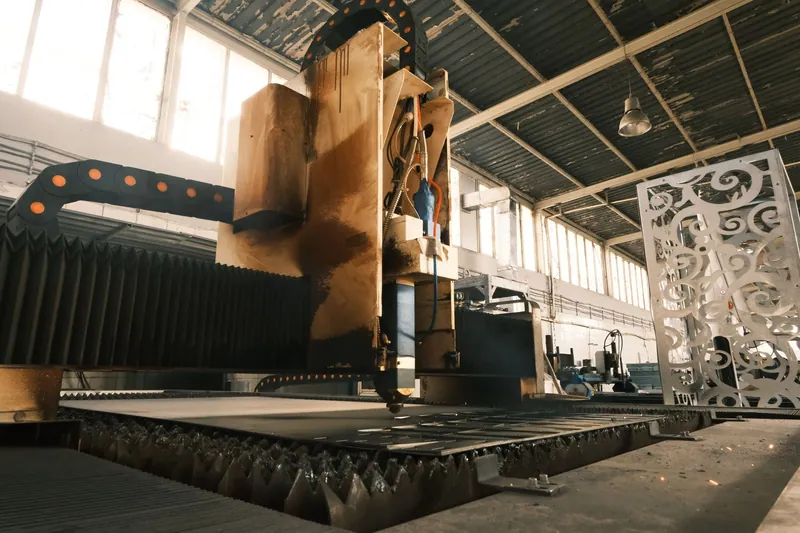
A jali is mostly holes, and every hole is something the laser has to cut. That is why jali panels, gate and grill panels, mandir screens, partitions and cut-through name plates cost more per square foot than plain parts. A few design choices decide whether a panel comes out strong and affordable or fragile and costly. This guide covers those choices, with real prices from our instant quote.
Why a jali costs more than a plain panel
A plain panel is a single cut around the outside. A jali has that same outline plus one closed cut for every opening, and each of those is a fresh start for the laser. More cutting takes more time, so it costs more.
Our two example panels show the difference. Both are 300 × 300 mm, which is 0.97 square feet. The plain square has 1.2 m of cutting in one outline. The jali is a 300 × 300 mm panel with 144 square openings of 15 mm (a 12 × 12 grid): 9.8 m of cutting in 145 separate cuts.
| Panel | Sheet | 1 piece | Each, at 10 pieces |
|---|---|---|---|
| Plain square | Mild steel, 2 mm | ₹436 | ₹327.30 |
| Jali panel | Mild steel, 2 mm | ₹1,181 | ₹1,073 |
| Plain square | MDF, 3 mm | ₹167 | ₹94.90 |
| Jali panel | MDF, 3 mm | ₹450 | ₹378 |
For a single piece, the jali comes to about 2.7 times the price of the plain square in mild steel and about 2.7 times in MDF. The sheet used is the same in both. Taking material out does not save sheet, because the panel still occupies its full rectangle. Everything extra is cutting.
Because the panel is close to one square foot, the table is also a fair guide to what this pattern costs per square foot. A more open pattern costs less and a finer one more. The price per panel falls as the quantity rises, and a small minimum order value applies to the whole order. The laser cutting price page has more examples.
Design rules that keep a jali strong and affordable
- Keep webs at least as wide as the sheet is thick. The web is the strip of material left between two openings. In 2 mm steel that means 2 mm at the very least. That minimum only gives a clean cut. Where the panel must resist a push, as in a gate or a window grill, make the webs two or three times the thickness.
- Go wider still in MDF and acrylic. Both are brittle, and a thin web snaps in handling long before a steel one would bend.
- Use bigger openings, not hundreds of tiny ones. Every opening adds its own outline and its own start. Doubling the size of the openings in a grid cuts their number to a quarter, and the panel looks much the same from across a room. Openings narrower than the sheet thickness do not cut cleanly in metal.
- Leave a solid border. An uncut margin all round stiffens the panel and gives room for screw holes, or for the edge to sit in a frame or channel. About 20 mm is a common starting point on a small panel. Allow more on a large one.
- Keep the pattern connected, with no islands. Anything fully surrounded by a cut line falls out. Check every motif: the centre of a ring, a leaf inside a flower, a star inside a circle. Tie each one to the rest of the panel with a bridge, and hold long pieces at two points or more so they cannot twist.
- Avoid long thin fingers and sharp points. They bend in metal, snap in MDF and catch on clothes and hands. A small radius on tips and inside corners makes the panel safer and stronger.
- Mind the heat in thin sheet. A very dense pattern puts a lot of heat into a small area. Thin metal can bow slightly and MDF edges darken. Wider webs and larger openings reduce both.
The general limits for holes, slots and spacing are in the laser cutting design rules guide.
Name plates and cut letters
The instant quote covers cutting, not engraving, so the lettering on a name plate is made in one of two ways.
Cut-through lettering
The letters are openings in the plate, like a stencil. The centres of A, B, D, O, P, Q and R, and of the digits 0, 4, 6, 8 and 9, are islands and drop out unless something holds them. Use a stencil font, or add bridges at least as wide as the sheet is thick. For a backlit name plate, a sheet of white acrylic behind the cut-through face spreads the light. The lighting and the assembly are yours to do.
Separate cut letters
Here each letter is its own piece, cut from acrylic or metal and fixed to a backing by you. Choose a bold typeface, because hairline strokes and thin script snap easily in acrylic. A joined script cut as one piece is stronger and easier to mount than loose letters. Remember that the dot of an i is a separate tiny piece, and pieces under 10 mm across are hard to handle.
Either way, convert the text to outlines before you export, because a DXF does not carry fonts.
For reference, a plain name plate blank (300 × 100 mm plate with rounded corners and two 5 mm fixing holes) is ₹191 in 3 mm acrylic and ₹407 in 1.5 mm stainless steel 304 for one piece, inclusive of all taxes. Cut-through lettering adds to that according to how much cutting it needs.
Which material for which job
| Use | Material | Why | Keep in mind |
|---|---|---|---|
| Gates, window grills, compound wall and elevation panels | Mild steel (MS) | Strong, easy to weld into a frame, and the lowest cost metal | Rusts if left bare. Have it painted or powder coated by a local coater after cutting. |
| Outdoor screens and balcony panels left unpainted | Stainless steel 304 (SS 304) | Does not rust in normal use, and the cut edge is bright and clean | Costs more than MS. For sea-facing sites, ask about SS 316. |
| Interior partitions, mandir panels, wall and ceiling decor | MDF | Lowest cost sheet, cuts fine detail and takes paint well | Indoor use only, as it swells if it gets wet. The cut edge is dark until sanded and painted. |
| Backlit name plates, cut letters and signs | Acrylic | Polished edge straight from the laser; clear, black and white sheet on the instant quote | Brittle in thin strokes. Coloured, mirror and frosted sheet are on request. |
On the instant quote we list mild steel from 1 mm to 12 mm, stainless steel 304 from 0.8 mm to 3 mm, acrylic from 2 mm to 5 mm, MDF from 3 mm to 6 mm. A panel held in a frame on all four sides can be thinner than one that has to stand on its own.
We cut the flat panel only. Frames, welding, painting, powder coating and fitting are work for your fabricator or contractor, so agree the panel size and the fixing method with them before you order.
Panel sizes and splitting a large screen
The largest single piece on the instant quote is 1000 × 600 mm, roughly 3.3 × 2 feet. An online order can weigh up to 25 kg packed, and steel adds up quickly, so check a large panel with the sheet metal weight calculator.
For a bigger screen there are two routes. Split it into panels that each fit the limit, or send a custom request for sheets up to 2500 × 1250 mm, which we check and quote by hand. If you split it:
- Divide at a natural repeat of the pattern, so the joints look intended.
- Give every panel its own border. Each one is stiffer, and the joints land on solid material.
- Make the panels identical where you can. One drawing ordered in quantity costs less per panel than several different drawings.
- Smaller panels also travel more safely by courier and are easier to handle and fit.
Preparing the drawing, and where to get a pattern
We take DXF and SVG files. A jali drawing has far more shapes than a bracket, so small drafting faults multiply. Check these before you upload:
- Draw at real size, in millimetres, at 1:1.
- Make every opening a closed shape, with no gaps at the corners.
- Remove duplicate and overlapping lines. Copying a tile across a grid often leaves two lines where the tiles meet, and a doubled line is cut twice.
- Keep the cut lines on one layer, and delete dimensions, notes, hatches, borders and title blocks.
- Convert text to outlines.
- Put one panel in each file, and set the quantity when you order.
Step-by-step help is in how to export a DXF for laser cutting.
Where to get a pattern
Draw your own: square, diamond and other geometric grids are quick to make with the array or pattern tool in any CAD or vector program. Or use a design you have the right to use, and check that its licence covers what you plan to do with it, especially if you will sell the result. We cut from your drawing and do not supply a catalogue of designs. If all you have is a sketch or a photograph, send it through a custom request and we will tell you whether we can help.
Getting a price and ordering
Upload the DXF or SVG on the quote page, choose the material and thickness, and the price appears straight away, inclusive of all taxes. Try a second version with larger openings and compare the two: it is the quickest way to see what a design change saves.
There is no minimum quantity. A person checks every drawing before it is cut. The panels are cut in Bengaluru, dispatched in 4 to 6 working days and couriered across India with a GST invoice.
Ready to cut?
Upload your DXF or SVG for an instant price, inclusive of all taxes. A person checks every drawing, and we ship across India.
Frequently asked questions
Why does a jali panel cost more than a plain sheet of the same size?
Laser cutting is priced largely on the length of cut and the number of separate openings. A jali has many times the cut length of a plain panel and one new start for every opening, while using the same amount of sheet. Fewer, larger openings bring the price down.
Which material should I choose for a jali: MS, SS or MDF?
Mild steel suits gates and grills and needs paint or powder coating against rust. Stainless steel 304 suits outdoor panels that will not be painted. MDF suits interior partitions and mandir panels that will be painted and kept dry.
What is the largest jali panel I can order online?
The instant quote takes single pieces up to 1000 × 600 mm. A larger screen is either split into panels within that size or sent as a custom request for sheets up to 2500 × 1250 mm, which we check and quote by hand.
Can you design a jali or name plate pattern for me?
We cut from your DXF or SVG drawing and do not supply a catalogue of designs. If you only have a sketch or a photo, send it through the custom quote form and we will tell you whether we can help and what it would need.
Do the centres of letters like O and A fall out when a name plate is laser cut?
Yes, anything fully enclosed by a cut line drops out. For cut-through lettering, use a stencil font or add small bridges that hold the centres in place. For separate cut letters, the centre is meant to fall away.