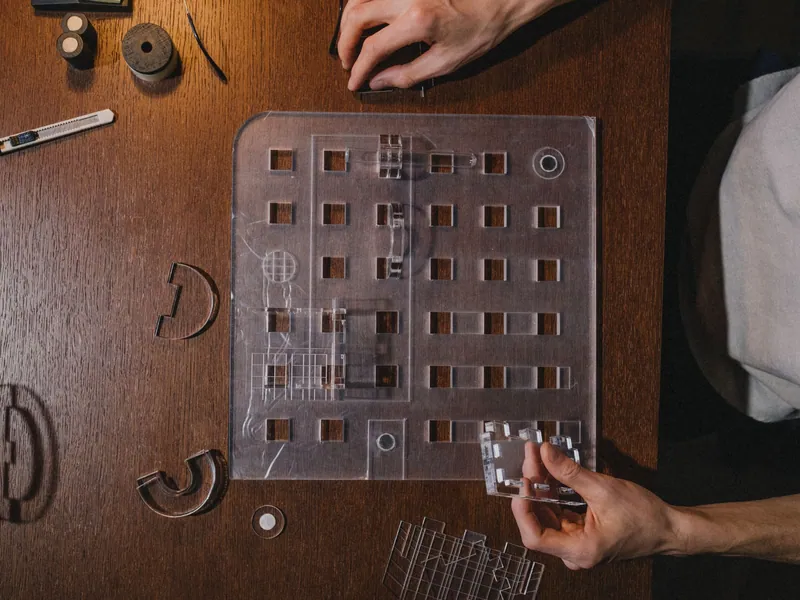
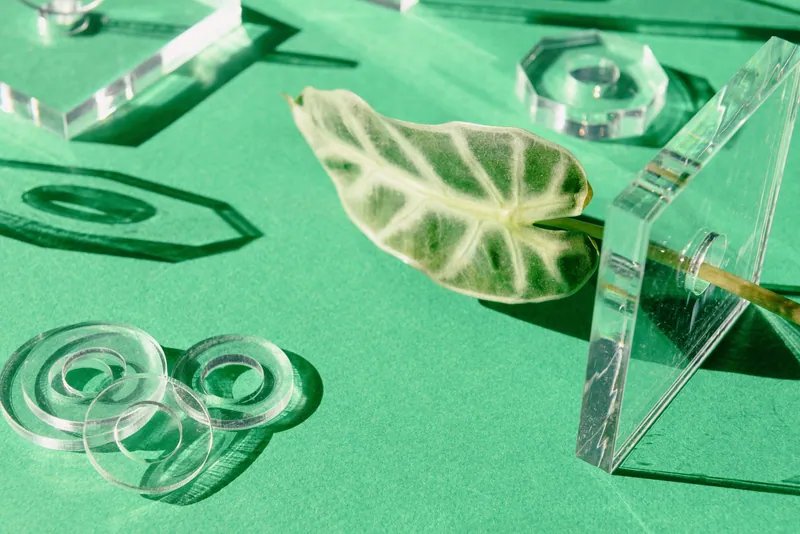
If you were searching for acrylic cutting near me, the shop does not have to be near you. We cut in Bengaluru and courier the parts anywhere in India, with the protective film still on the sheet.
The sheet we cut: cast acrylic
We cut cast acrylic (PMMA) sheet. Acrylic is sold in two types, cast and extruded, and they behave differently. Cast sheet has less built-in stress, so it is less likely to craze or crack around cuts and holes. Its thickness varies a little more than extruded sheet, which matters for tight slot fits.
The instant quote lists three sheets: clear, black and white. Coloured, mirror and frosted acrylic are not on the instant quote. For those, send a custom request.
Acrylic is about half the weight of glass and stands up well to sunlight and weather. It scratches more easily than glass, and it softens with heat, so keep it away from hot lamps and heaters.
How the laser cuts acrylic and what the edge looks like
Acrylic is cut on a CO2 laser. The beam vaporises the plastic along the line and leaves a smooth, glossy, flame-polished edge straight off the laser. There is no charring and there are no saw marks.
The kerf is a little wider than in metal, and on thick sheet the edge can have a very slight taper. Typical tolerance is about ±0.2 mm. Sheets ship with their protective film on, which keeps the faces free of scratches until you peel it.
Designing acrylic parts and acrylic letters
Holes and slots should be at least half the sheet thickness wide, and never under 1 mm. Keep holes away from the edge: leave at least one sheet thickness of material around a hole, and more for holes that take screws. Acrylic can crack if a hole sits too close to an edge.
Sharp inside corners are where cracks start. Add a small radius to every inside corner, above all on parts that will be clipped together or screwed down. Avoid long thin strips and fine points, which snap easily.
For acrylic letters, convert the text to outlines before you export the DXF or SVG, because text objects are not cut. As a rule of thumb, keep the thinnest stroke of a letter at least as wide as the sheet is thick. Very small pieces, such as the dot of an i, are left on a small tab that you snap off.
After cutting: film, cleaning, joining
Leave the protective film on until the part is installed. Clean acrylic with water, a drop of mild soap and a soft cloth. Do not use thinner, acetone or alcohol-based cleaners: solvents can cause fine cracks (crazing), mostly along cut edges.
Parts can be joined with acrylic cement, fixed with screws and washers, or mounted on standoffs. Do not over-tighten screws, and make screw holes slightly oversize so the sheet is not stressed.
The instant quote covers cutting only. Engraving and heat bending are not part of it. If you need them, send a custom request.
Acrylic, MDF or something else?
Choose acrylic when the part should be clear or glossy, will be seen up close, or may get wet. Choose MDF when the part will be painted, is for a model or a mock-up, and low cost matters more than looks.
Acrylic is rigid but brittle. It can crack under a sharp blow, so for guards that must take impact, polycarbonate is the usual material, and it is not on the instant quote. We also do not laser cut PVC sheet or PVC foam board, because PVC gives off corrosive hydrogen chloride fumes under a laser.