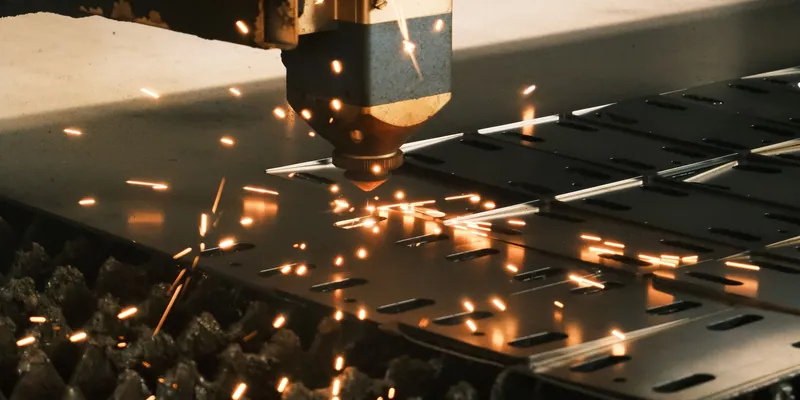
How thick a laser can cut depends on three things: the material, the kind of laser, and how clean the edge has to be. This guide starts with the thickness chart for the sheet we cut in Bengaluru. It then explains in plain terms why the limits sit where they do, what a laser should never be asked to cut, and what changes at the edge as the sheet gets thicker.
Laser cutting thickness chart: what we cut
This chart is built from the same material list the quote page uses, so it matches what you can order today. All thicknesses are in millimetres.
| Material | Grade | Thickness we cut | Laser | Cut edge |
|---|---|---|---|---|
| Mild steel | CRCA up to 2 mm, hot-rolled (HR / IS 2062) above | 1 mm to 12 mm | Fibre laser, oxygen assist gas | Square, slightly dark edge from oxygen cutting. Paint or powder coat it to stop rust. |
| Stainless steel 304 | AISI 304, 2B mill finish | 0.8 mm to 3 mm | Fibre laser, nitrogen assist gas | Clean, bright, oxide-free edge from nitrogen cutting. Ready to weld without grinding. |
| Aluminium | 5052-H32 or equivalent sheet grade | 1 mm to 3 mm | Fibre laser, nitrogen assist gas | Clean edge from nitrogen cutting, with a light burr on the underside of thicker sheet. |
| Galvanised steel | GI / GP sheet, zinc coated both sides | 0.8 mm to 2 mm | Fibre laser, nitrogen assist gas | The cut edge itself is bare steel; the zinc on both faces protects it for most indoor and sheltered use. |
| Acrylic | Cast acrylic sheet | 2 mm to 5 mm | CO2 laser | Smooth, glossy, flame-polished edge straight off the laser. Sheets ship with their protective film on. |
| MDF | Plain interior-grade MDF | 3 mm to 6 mm | CO2 laser | Dark brown, lightly charred edge. Sand and paint for a finished look. |
Every thickness on the list, material by material:
- Mild steel: 1, 1.2, 1.5, 2, 3, 4, 5, 6, 8, 10, 12 mm
- Stainless steel 304: 0.8, 1, 1.2, 1.5, 2, 3 mm
- Aluminium: 1, 1.5, 2, 3 mm
- Galvanised steel: 0.8, 1, 1.2, 1.5, 2 mm
- Acrylic: 2, 3, 5 mm
- MDF: 3, 6 mm
If you think in gauge, order in millimetres instead, because gauge numbers differ between standards. As a rough guide, 20 gauge is about 0.9 mm, 18 gauge about 1.2 mm, 16 gauge about 1.6 mm and 14 gauge about 2 mm.
The largest single piece on the instant quote is 1000 × 600 mm. Larger sheets (up to 2500 × 1250 mm), thicker plate and anything missing from the chart go through a custom request: we check whether we can cut it and reply with a price.
Materials we cut on request
These are not on the instant quote. Ask first, and we confirm each job before taking it.
- Stainless steel 316 (marine and chemical grade)
- Brass (up to 3 mm)
- Copper (up to 2 mm)
- Spring steel and wear plate (tell us the grade)
- Plywood and veneer boards (3 mm to 6 mm)
- Coloured, mirror and frosted acrylic (any colour your sheet supplier lists)
Which laser cuts which material
Three kinds of laser are in common use. They differ in the wavelength of their light, and that decides which materials absorb the beam well enough to be cut.
| Laser | Suits | Poor fit |
|---|---|---|
| Fibre laser | Metals: mild steel, stainless steel, aluminium, galvanised sheet, brass and copper | Wood, clear acrylic and most other non-metals |
| CO2 laser | Acrylic, wood, MDF, plywood, paper and card, fabric, leather and laser-grade rubber | Reflective metals such as brass and copper. For steel, fibre lasers have largely taken over |
| Diode laser | Thin wood, card and leather, and engraving: hobby and craft work | Metal cutting, clear acrylic and thick sheet of any kind |
We cut metal with fibre lasers, and acrylic and MDF with CO2 lasers. Mild steel is cut with oxygen as the assist gas. Stainless steel, aluminium and galvanised sheet are cut with nitrogen.
Why thickness is limited
A laser cuts by melting a thin line through the sheet while a jet of gas blows the molten material out of the bottom. Four things decide how deep that can go.
- Laser power. Thicker sheet needs more energy to melt through its full depth. Every laser has a thickness beyond which the cut stops clearing or the edge turns rough. More power moves that point further out.
- Assist gas. With mild steel, oxygen reacts with the hot metal and adds heat of its own, which is why mild steel can be cut thicker than other metals on the same laser. Stainless steel and aluminium are cut with nitrogen. It adds no heat, so all the work falls on the beam, but it leaves a bright edge free of oxide.
- Heat. A slow cut through thick sheet puts more heat into the part. Small features in thick plate can overheat, corners round over, and acrylic and MDF melt or char more.
- Reflective metals. Aluminium, brass and copper reflect much of the beam and carry heat away from the cut quickly. They need more power than steel for the same thickness, so their limits are lower.
That is why most thickness charts, ours included, stop earlier for stainless steel and aluminium than for mild steel, and why brass and copper are cut in thin sheet only.
Why thick plate cuts slower and costs more
Cutting speed falls quickly as thickness rises, because the beam has to melt more metal for every millimetre it travels. A cut that races through 1 mm sheet moves at a small fraction of that speed in 10 mm plate. Piercing, the moment the beam first punches through, also takes longer, and more assist gas is used.
The sheet costs more too. Weight rises in step with thickness, so a 6 mm plate holds three times the steel of a 2 mm one. Both effects show in the price.
| Thickness | Weight each | Each, at 10 pieces | Each, at 100 pieces |
|---|---|---|---|
| 1 mm | 13 g | ₹32.10 | ₹21.26 |
| 1.2 mm | 16 g | ₹32.10 | ₹21.26 |
| 1.5 mm | 19 g | ₹32.10 | ₹21.26 |
| 2 mm | 26 g | ₹35.50 | ₹24.70 |
| 3 mm | 39 g | ₹42.90 | ₹32.11 |
| 4 mm | 52 g | ₹52.40 | ₹41.53 |
| 5 mm | 65 g | ₹59.80 | ₹48.95 |
| 6 mm | 78 g | ₹69.20 | ₹58.37 |
| 8 mm | 104 g | ₹86 | ₹75.20 |
| 10 mm | 129 g | ₹104.90 | ₹94.04 |
| 12 mm | 155 g | ₹124.60 | ₹113.77 |
At 100 pieces, the 12 mm part costs about 5.4 times what the 1 mm one does, for exactly the same outline. So choose the thinnest sheet that does the job. Check what a part will weigh with the sheet metal weight calculator, and see more worked examples on the laser cutting price page.
What happens to the edge as thickness goes up
Thin sheet comes off the laser with a smooth, nearly square edge. As the sheet gets thicker, four things change.
- Striations. The fine vertical lines left by the beam get deeper and easier to see.
- Taper. The cut is slightly wider at one face than the other, so a thick edge is not perfectly square. It is hard to see on thin sheet and shows more on thicker plate.
- Burr. A little metal can cling to the underside where it has set again, most often on thick aluminium.
- Heat-affected zone. This is the band of metal beside the cut that got hot enough to change. With a laser it is small, typically a fraction of a millimetre, and it grows a little with thickness.
Acrylic keeps its glossy edge at every thickness, but thick sheet shows faint lines and a slight taper. MDF chars more as it gets thicker, so the edge goes from brown towards black.
Typical accuracy is about ±0.2 mm. The laser removes a kerf of about 0.1 to 0.3 mm in metal, and a little more in acrylic and MDF. These are typical values, not guarantees, and thick plate sits at the wider end.
Minimum feature sizes grow with thickness
- Holes and slots in metal: at least as wide as the sheet is thick. A 3 mm hole is fine in 2 mm sheet. In 8 mm plate the smallest sensible hole is 8 mm, and anything smaller is drilled after cutting.
- Holes in acrylic and MDF: about half the sheet thickness, and not under about 1 mm.
- Webs between cut-outs, and the gap from a hole to the edge: at least the sheet thickness.
The full list is in the laser cutting design rules guide.
What a laser cannot or should not cut
- PVC, vinyl and PVC foam board (sunboard). Heated by a laser, they give off hydrogen chloride, an acid fume that is harmful to breathe and corrodes the machine. They are cut with a router or a knife instead.
- Polycarbonate. Under a laser it tends to melt, discolour and char at the edge, so it does not cut cleanly. Use acrylic where you can, or have polycarbonate routed.
- Glass and stone. A laser can mark the surface but will not cut through cleanly. These are jobs for waterjet or diamond tools. Toughened glass cannot be cut by any process once it has been toughened: it shatters.
- Very thick plate and thick reflective metal. Beyond what a laser cuts cleanly, plasma, oxy-fuel, waterjet or machining take over.
- Unknown plastics. If nobody can say what a sheet is made of, it should not be laser cut.
Our comparison of laser cutting, waterjet, plasma, CNC routing and 3D printing covers which process to ask for instead.
Choosing a thickness and ordering
Upload a DXF or SVG on the quote page, pick a material and thickness, and the price appears straight away, inclusive of all taxes. Switch thickness to see what a step up or down costs. There is no minimum quantity, and the price per piece falls as the quantity rises.
A person checks every drawing before it is cut. Parts are cut in Bengaluru, dispatched in 4 to 6 working days and couriered across India with a GST invoice. Not sure which metal to pick? Read MS vs SS vs aluminium sheet, or browse the materials page.
Ready to cut?
Upload your DXF or SVG for an instant price, inclusive of all taxes. A person checks every drawing, and we ship across India.
Frequently asked questions
How thick can a laser cut steel?
High-power industrial fibre lasers cut mild steel plate 20 mm thick and more, but speed and edge quality fall as the thickness rises. On our instant quote, mild steel is listed from 1 mm to 12 mm and stainless steel 304 from 0.8 mm to 3 mm; thicker plate is a custom request.
What materials can laser cutters cut?
Fibre lasers cut metals: mild steel, stainless steel, aluminium, galvanised sheet, brass and copper. CO2 lasers cut acrylic, wood, MDF, plywood, paper, fabric and leather. PVC, polycarbonate, glass and stone are not suitable for laser cutting.
Why can PVC not be laser cut?
PVC and vinyl contain chlorine, and a laser releases it as hydrogen chloride fumes that are harmful to breathe and corrode the machine. That includes PVC foam board, often sold as sunboard. These sheets are cut with a router or a knife instead.
Can a fibre laser cut acrylic, wood or MDF?
Not well. Clear acrylic lets the light of a fibre laser pass through, and wood and MDF scorch under it without cutting cleanly. These sheets absorb the longer-wavelength light of a CO2 laser, so acrylic, wood and MDF are cut on CO2 lasers and metals on fibre lasers.
Why does thicker sheet cost more to laser cut?
There is more material in the part, and the laser has to travel more slowly to cut through it. Piercing also takes longer in thick plate. Choosing the thinnest sheet that does the job is the simplest way to lower the price.