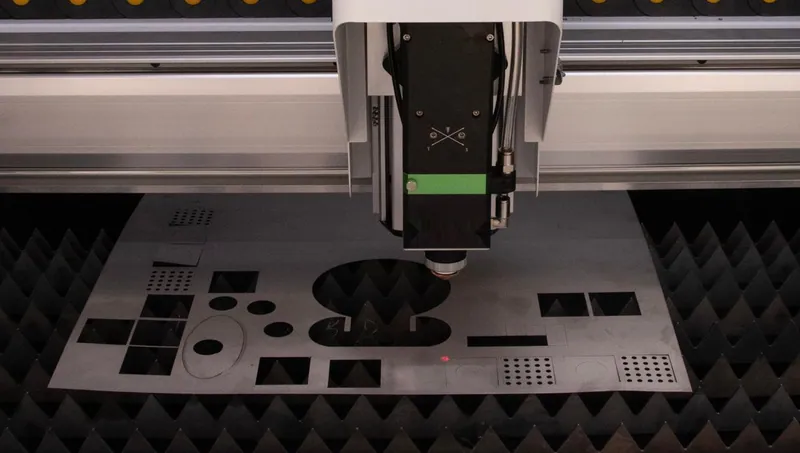
Ask three shops what laser cutting costs and you will get three kinds of answer: so much per square foot, so much per kg, or so much per minute on the machine. All three are honest ways to quote, yet none tells you what your own part will cost. This guide explains how laser cutting cost is calculated in India, what pushes a price up or down, and how to bring it down before you order.
What drives the price of a laser-cut part
Six things decide the price. Every instant price on our quote page is built from them, and so, in one form or another, is every job-shop estimate.
- Length of cut. The laser travels along every outline and around every hole, and twice the length takes about twice as long. For jali panels, gears and lettering this is the largest item.
- Number of pierces. Every closed shape starts with a pierce through the full sheet: one for the outline and one for each hole or cut-out. A pierce takes time, more so in thick plate, so a hundred small holes cost more than their length of cut suggests.
- Sheet material. Stainless steel and aluminium sheet cost more per kg than mild steel, and they are cut with nitrogen, which costs more than the oxygen used for mild steel. Acrylic and MDF are cut on CO2 lasers and have their own sheet prices.
- Thickness. Thicker sheet cuts slower, so each metre of cut costs more, and there is more material under the part. Going from 2 mm to 5 mm adds cutting time as well as weight.
- How much sheet the part occupies. You pay for the rectangle of sheet the part is cut from, plus a small gap between parts, not only for the metal that ends up in your hand. An L-shaped bracket or a large ring uses far more sheet than its weight suggests.
- Setup and quantity. Each drawing is programmed, loaded, sorted and packed once, however many pieces are cut from it. That one-time setup is shared across the quantity, so the price per piece falls as the quantity rises.
Why a laser cutting price per sq ft or per kg misleads
Rates per square foot and per kg are popular because they are easy to compare. The trouble is that they leave out the two things that matter most: the length of cut and the number of pierces. Take two panels of the same size, 300 × 300 mm, both in 2 mm mild steel. One is a plain square. The other is a jali panel with 144 square openings cut into it.
| Plain square | Jali panel | |
|---|---|---|
| Length of cut per piece | 1.2 m | 9.8 m |
| Pierces per piece | 1 | 145 |
| Price per piece | ₹327.30 | ₹1,073 |
| The same price per sq ft | ₹338 | ₹1,107 |
| The same price per kg | ₹232 | ₹1,186 |
| The same price per metre of cut | ₹273 | ₹109 |
Same size, same sheet, same quantity, and the jali costs about 3 times what the plain square does. Per square foot the gap is just as wide. Per kg it is wider still, because about 36% of the jali has been cut away: it weighs less and costs more. Even the figure per metre of cut differs between the two, since the sheet under the part and the pierces are in the price as well.
So a flat laser cutting price per square feet is really an average for the kind of work a shop usually does. If your design is plainer than that average you overpay, and if it is denser, expect the quote to change once the shop sees the drawing. A price worked out from the drawing itself avoids both.
How quantity changes the price per piece
There is no minimum quantity: one piece is fine. But the setup for a drawing is charged once, so a single piece carries all of it and a hundred pieces share it. Here is one part, a base plate (100 × 100 mm plate with four 6 mm holes), at different quantities.
| Quantity | Mild steel 3 mm | Stainless steel 304 3 mm | Acrylic 3 mm |
|---|---|---|---|
| 1 piece | ₹208 | ₹351 | ₹127 |
| 5 pieces | ₹111.60 | ₹254.20 | ₹62.40 |
| 10 pieces | ₹99.60 | ₹242.20 | ₹54.40 |
| 25 pieces | ₹92.32 | ₹235.04 | ₹49.56 |
| 50 pieces | ₹89.94 | ₹232.62 | ₹47.96 |
| 100 pieces | ₹88.73 | ₹231.42 | ₹47.16 |
The drop is steepest over the first few pieces and then flattens, because by then the price is mostly sheet and cutting, which do not shrink with quantity. If you will need spares, order them with the first batch. Very small orders are also topped up to a small minimum order value, so one tiny washer on its own is not an economical way to buy.
Per minute, per hour, per metre: how job shops quote laser cutting charges
Many job shops in India quote job work by machine time: so much per minute or per hour of cutting, usually on sheet that the customer brings. Others quote per metre or per millimetre of cut, with a charge for each pierce. Decorative panels are commonly quoted per square foot, and heavier fabrication per kg.
These are all the same sum seen from different sides. Machine time is the length of cut divided by the cutting speed, plus the pierces. A laser cutting price per meter is machine time turned into distance for one thickness. A price per sq ft or per kg is that again, averaged over a typical pattern, with the sheet added in.
When you compare quotes, check what each one includes:
- Is the sheet included, or do you supply it?
- Is GST included, or added on top?
- Is there a programming or setup charge, or a minimum charge?
- Who pays for delivery, and do the offcuts come back to you?
Our prices are for the finished part: sheet, cutting and setup, inclusive of all taxes, with a GST invoice with every order. Delivery is added in the cart from your pincode, before you pay.
How to lower your laser cutting cost
- Use fewer, larger holes. Where the function allows it, a few large openings cost less than many tiny ones: fewer pierces and usually less length of cut. Ventilation is the usual case, where a few slots can replace a field of small holes.
- Go thinner if the part is strong enough. Thinner sheet costs less and cuts faster. Check whether 3 mm was drawn out of habit where 2 mm would do.
- Order several at once. The setup is shared, so ten pieces cost far less each than one.
- Share common sizes. Every different drawing has its own setup. If a left and a right bracket can be one symmetrical part, or two plates can share one size and hole pattern, you order one drawing at a higher quantity.
- Leave out needless detail. Decorative cut-outs, scalloped edges and very fine lettering all add length of cut. Keep what the part needs.
- Remove duplicate lines. A line drawn twice is cut twice. The quote page removes exact duplicates on its own, but lines that only partly overlap still count, so clean the drawing first.
Material matters as well: the same part costs much less in mild steel than in stainless steel. Our guide to mild steel vs stainless steel vs aluminium compares them, and the design rules cover hole sizes and spacing.
Is laser cutting expensive?
For flat parts, usually not. Laser cutting needs no die, mould or special tooling, so there is nothing to pay for before the first piece, and a design change costs only a new drawing. That is why it suits one-off brackets, prototypes, college projects and short production runs.
It feels expensive mainly in two cases: a single small part, where the setup and the minimum order value outweigh the part itself, and a very dense pattern in thick stainless steel, where the laser has a lot of work to do. For very thick plate another process may suit better: see laser cutting vs waterjet, plasma and CNC.
Get the exact price for your drawing
The quickest way to know what a part costs is to price the real drawing. Upload a DXF or SVG on the quote page, choose the material, thickness and quantity, and the price appears at once, inclusive of all taxes. Switch between materials and quantities to see what each does to the price. No drawing yet? Try the laser cutting cost calculator, or see example prices for common parts on the laser cutting price page.
You pay online, and a person checks every drawing before it is cut. Parts are cut in Bengaluru, dispatched in 4 to 6 working days and couriered across India.
Ready to cut?
Upload your DXF or SVG for an instant price, inclusive of all taxes. A person checks every drawing, and we ship across India.
Frequently asked questions
How much does laser cutting cost per sq ft in India?
There is no single rate, because the price depends on the length of cut, the number of holes, the material and the thickness, and not on area alone. For example, at 10 pieces in 2 mm mild steel a plain 300 × 300 mm square works out to ₹338 per sq ft and a jali panel of the same size to ₹1,107 per sq ft, inclusive of all taxes. Upload your drawing for the exact price of your part.
Is laser cutting charged per kg, per metre or per hour?
All of these are used in India. Job shops often charge by the minute or hour of machine time, or per metre of cut, on sheet the customer supplies, while panels are quoted per sq ft and heavy fabrication per kg. They are different views of one sum: cutting time plus sheet plus setup.
Why does a single laser cut piece cost more than each piece of a batch?
Because the one-time setup for the drawing is not shared with any other pieces. There is still no tooling to pay for, so a single bracket or prototype is practical. Ordering a few spares together brings the price per piece down quickly.
What changes to a drawing bring the laser cutting price down?
Cut less and pierce less: use fewer, larger holes, drop decorative detail and remove duplicate lines from the drawing. Choose the thinnest sheet that is strong enough, and order all the pieces you need in one go so the setup is shared.